
Home / Founder's Corner / How to Write a Job Description That Actually Attracts the Right Candidates
Most founders spend months deciding which tools to build their product on. They debate hiring decisions for weeks. And then they spend 20 minutes writing the job description that leads to who joins the team.
That mismatch is where bad hires begin.
A job description isn’t an administrative task. It’s the first filter in your hiring process and if it’s broken, everything that comes after is more expensive. You screen more people, waste more time, and occasionally make the wrong call.
42% of employers have had to revise or completely rewrite job descriptions because they were attracting the wrong applicants. That’s not a sourcing problem. That’s a communication problem.
This post walks through a practical framework for writing job descriptions that work in both pulling in candidates who are qualified and reflecting the wrong ones away.
TL;DR — Most job descriptions attract the wrong candidates – or repel the right ones – right away. Write for the outcome, not the ideal résumé: use a standard job title, lead with what the role owns, separate must-haves from nice-to-haves, and mentioning the salary is a must. A well-crafted description filters out mismatched applicants automatically, saving you hours of screening time.
Why Most Job Descriptions Are Broken
The average candidate spends just 14.6 seconds reading the requirements section of a job description before deciding whether to continue or move on. That’s not apathy — it’s a signal that the description isn’t doing its job.
The Candidate Who Never Applies
According to research compiled by Insight Global, 52% of job seekers say the quality of a job description is very or extremely influential on their decision to apply. That includes clarity, formatting, tone, and specificity. A description that reads like an internal document — full of jargon, an unrecognizable job title, and a 25-bullet requirements list — signals exactly what it’s like to work there.
The best candidates have options. They move on quickly. A vague or poorly written description doesn’t just fail to attract them. It actively signals, ‘This company doesn’t know what it needs.’
When the Wrong People Show Up
On the other side of the same problem: unclear descriptions attract unqualified applicants. Research from Dover’s startup hiring guide shows that 63% of candidates didn’t apply to a role because they couldn’t understand the specific skills or tools required. The ones who did apply despite unclear requirements often aren’t the best fit — they applied because ambiguity gave them room to hope.
The downstream cost compounds fast. According to SHRM, the average cost of a bad hire can reach $240,000 when you account for salary, recruitment costs, training, lost productivity, and replacement. Vague job descriptions are one of the earliest points where that cost accumulates.
$240,000
Average cost of a bad hire — SHRM
Before You Write a Single Word, Define the Job — Not the Person
The most common mistake founders make when writing job descriptions is starting with the candidate they imagine, not the job that needs to be done.
As a16z notes in their guide to early-stage hiring mistakes, founders who rush descriptions and copy generic templates create misalignment from day one — before the first interview is even scheduled.
Define the Outcome, Not the Résumé
Start with one question: what does success look like in this role at 30, 60, and 90 days? Not ‘What experience should this person have?’ but ‘What will they actually own, build, or improve?’ When you anchor the description to outcomes, the requirements become obvious. You stop padding the list with nice-to-haves and stop excluding candidates who’d be excellent but don’t match a generic template.
This framing also sharpens your interview process. If you know what the role needs to produce, you can evaluate based on demonstrated ability rather than assumed credentials. It also forces you to think through what those first 90 days should look like once they’re hired — which most founders leave undefined until it’s too late.
Know Whether You're Solving a Problem or Filling a Role
There’s a difference between hiring because you need a function covered and hiring because you have a specific, scoped problem to solve. Remote-first teams in particular often blur this line — they hire a ‘marketing manager’ when they need someone to own one campaign or bring on a ‘head of ops’ when a project coordinator would do.
This distinction also matters for classification. Whether you’re bringing on an employee or a contractor, the description needs to reflect the actual working relationship — not just the title. Getting that wrong carries legal consequences that extend well beyond the hiring process itself.
The Anatomy of a High-Performing Job Description
Once you know what the role needs to deliver, the writing is straightforward. Here’s the structure that consistently produces better applicant pools.
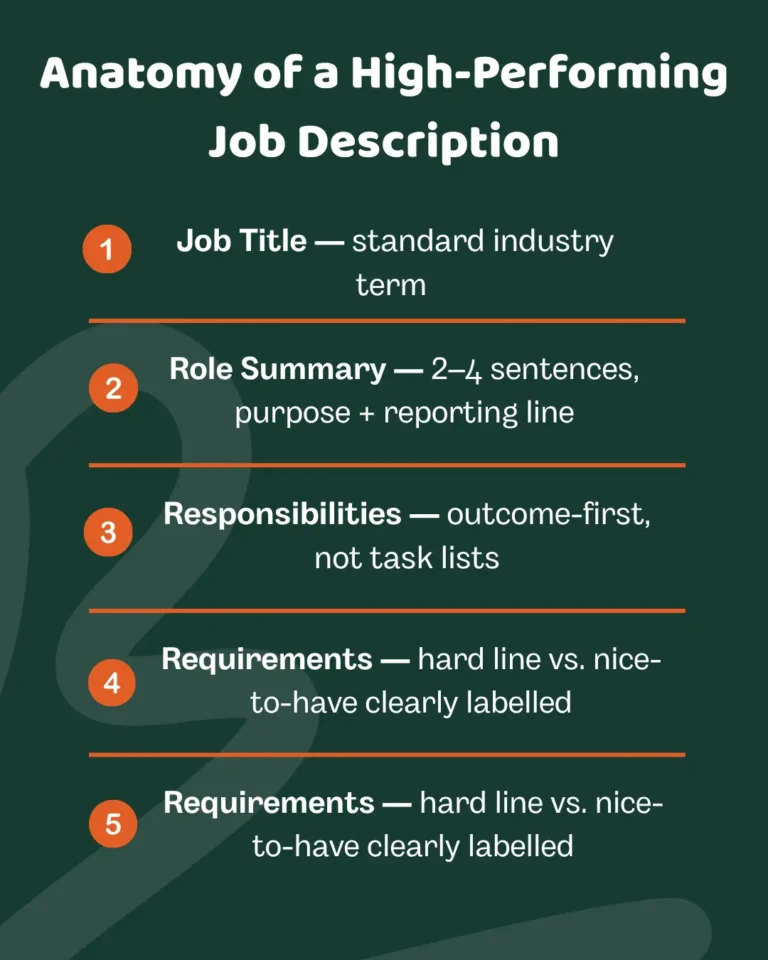
Job Title — Standard Over Creative
Use the title candidates actually search for. Research from Indeed shows 36% of candidates search for jobs by title. ‘Growth Hacker’, ‘Culture Champion’, or ‘People Experience Leads don’t surface in those searches — and the candidates who find them often don’t know what they’re actually applying for. Use the standard industry title. Save creative framing for the role summary.
Creative job titles are only valid as a decorative title on a website and for internal hiring and promotions. But it is still discouraged.
Role Summary — One Paragraph, One Clear Purpose
Two to four sentences. What the role does, who it reports to, and why it matters. HR Morning’s research on job description best practices shows that more than 70% of candidates say it’s very important to see how the role connects to company direction. The role summary is where you answer that — before they’ve read a single requirement.
Responsibilities — Outcomes First, Tasks Second
Write responsibilities as things the person will own, not tasks they’ll perform. ‘You will own our monthly reporting and turn data into decisions for the leadership team’ lands differently than ‘Responsible for reports’. ‘ Outcomes-driven language attracts candidates who think in terms of impact. Task-driven language attracts candidates who think in terms of hours.
Requirements — Hard Line vs. Nice-to-Have
Separate must-haves from nice-to-haves clearly and explicitly. Inflated requirements lists consistently reduce application rates among qualified candidates. If you have 12 requirements and 6 of them are genuinely optional, say so. Label them as ‘Nice to have’ or ‘Bonus’. A shorter, more accurate list produces a better candidate pool than a comprehensive wish list.
Salary and Compensation — Include It
Include a salary range. Sixty-one percent of applicants say compensation is the most important element of a job description. Withholding it doesn’t give you leverage in negotiation — it removes your post from consideration for candidates who know their market value. For remote roles, specify whether the range is location-adjusted or globally consistent. Either answer is fine. No answer costs you, candidates.
Common Questions Founders Ask About Writing Job Descriptions
Keep it under 300 words. Data shows shorter descriptions get 8.4% more responses. Cut the padding and only include requirements that are truly disqualifying. Every sentence must earn its place.
Always. Transparency is a filter. If you hide the pay, you’ll waste hours interviewing candidates who won’t accept the offer. Showing the range saves time and signals a culture of directness.
Your signals are weak. Usually, it's one of three: an unrecognisable job title, vague requirements, or a lack of seniority markers. If a stranger can’t tell exactly who you need within ten seconds, you’ll get a wide, mismatched spread.
Hard constraints. Be explicit about time zone overlaps (e.g., "4 hours of EST overlap required") and async norms. Ambiguity in remote roles is expensive; set clear expectations before the hire, not during onboarding.
When a Great Job Description Still Isn't Enough
A well-written job description is necessary. It’s not sufficient.
The Sourcing Problem Is Separate from the Description Problem
A job post only reaches candidates who are actively searching. The people you actually want — high performers who are currently employed and not actively looking — will never see it. That’s not a description problem. That’s a pipeline problem.
The founders who consistently make strong hires don’t just write better job descriptions. They build processes that keep qualified candidates moving through predictably — without starting from scratch every time a role opens.
As Sarah Purvlicius at Woven Teams noted after working directly with RZ HR Studio, the measure of a great HR system isn’t what it produces once. It’s that you’d call on it again every time — and trust it to work.
Building a Talent Pipeline Before You Need to Hire
If you’re posting only when you have a gap to fill, you’re already behind. The hidden cost of reactive hiring isn’t just the time spent sourcing. It’s the pressure on your existing team while the seat is empty and the shortcuts taken in screening because you need someone fast.
For founders scaling past 10 employees, a pre-built talent pool removes the sourcing bottleneck entirely. If you want to skip the sourcing step and access a pool of pre-vetted candidates who are already screened and ready to interview, that’s the infrastructure that changes how hiring feels — from reactive and stressful to intentional and fast.
Build the Filter First
A job description is the first conversation your company has with the people you want to hire. Most founders treat it like a formality. The framework here isn’t complicated: define the outcome before the person, structure the description around what’s real, and be direct about compensation. Done well, the right candidates recognize themselves immediately.
The harder truth is that a great job description is one piece of a hiring process that most early-stage companies haven’t fully built yet. If hiring feels reactive, inconsistent, or expensive to run, that’s the signal to fix the infrastructure — not just the job post.
Your Hiring Partner
At RZ HR Studio, we embed directly into your business and build the people infrastructure that protects you — including workforce classification frameworks tailored to your team structure, your geography, and your growth stage.
Book a Free Discovery CallNo pitch. Just clarity on where your workforce classification stands — and what it would take to make it bulletproof.