
You hired someone to help you grow your business.
Now comes the question most founders get wrong — sometimes without even knowing it.
Are they an employee or a contractor?
It sounds administrative. It isn’t. The employee vs contractor distinction is one of the most consequential decisions a founder makes — and one of the most commonly mishandled. The IRS, the Department of Labor, and employment regulators globally have specific definitions for each classification. And if your classification doesn’t match theirs, you’re not just making a paperwork error.
You’re creating a liability.
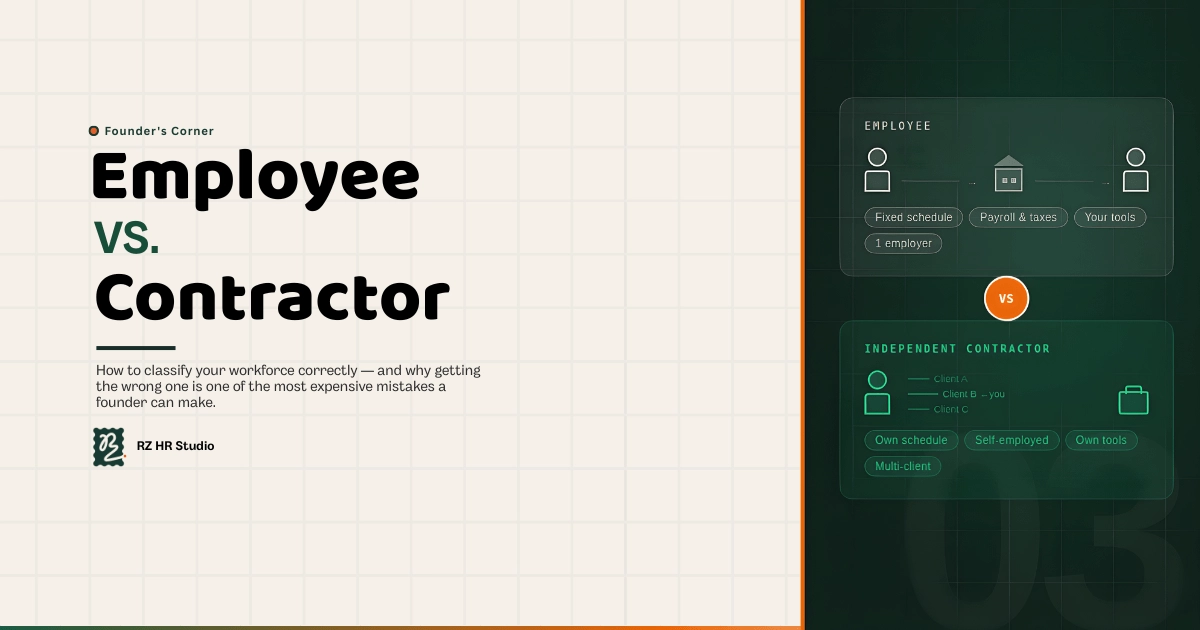
TLDR – An employee works under your direct control, on your schedule, using your tools, and receives benefits and tax withholdings. An independent contractor operates independently, sets their own hours, may use their own tools, and handles their own taxes. Misclassifying one as the other carries serious legal and financial penalties.
What Is the Difference Between an Employee and a Contractor?
The distinction isn’t about what you call someone or what your contract says. It’s about the nature of the working relationship — and regulators look past labels to find the reality of the working relationship.
The Core Definition of an Employee
An employee works under your direction and control. You decide:
- When they work
- Where they work
- How they complete their tasks
You withhold income tax, pay employer-side payroll taxes, and are typically responsible for benefits. The economic reality is that the employee is dependent on your business for their income.
The Core Definition of a Contractor
A contractor operates with independence. They:
- Set their own schedule and work hours
- Use their own equipment, and processes
- May work for multiple clients simultaneously
- Handle their own taxes — including self-employment tax
The economic reality is that a contractor runs their own business. You are one of their clients — not their employer.
Why the Employee vs Contractor Classification Actually Matters
This is where most founders underestimate the importance of definitions.
Misclassification isn’t a grey area governments tolerate. It’s an enforcement priority — because misclassifying employees as contractors allows businesses to avoid payroll taxes, deny benefits, and sidestep employment protections.
Regulators are mandated to look for irregularities.
The Financial Cost of Misclassification
If an employee is misclassified as a contractor and audited, your business may owe:
- Back payroll taxes — both employer and employee portions
- Unpaid benefits — retroactive health insurance, retirement contributions, paid leave
- Penalties and interest on all unpaid amounts
- Legal fees if the worker files a complaint or lawsuit
The U.S. Department of Labor recovered $274 million in back wages and damages during Fiscal Year 2023. — largely from misclassification cases. This is not a theoretical risk.
| Metric | FY 2023 Data |
|---|---|
|
Total Back Wages Recovered
|
$274.3 Million |
|
Workers Impacted |
~163,000 |
|
Primary Violation Category |
Overtime (FLSA) |
|
Average Recovery |
~$1,680 per worker |
TLDR – An employee works under your direct control, on your schedule, using your tools, and receives benefits and tax withholdings. An independent contractor operates independently, sets their own hours, may use their own tools, and handles their own taxes. Misclassifying one as the other carries serious legal and financial penalties.
The Reputational Cost
Beyond the financial hit, a misclassification finding damages trust — with your team, your investors, and your future hires. It signals that your people operations aren’t under control. For a founder in a funding conversation, that’s a serious red flag.
How to Determine Classification: Frameworks You Actually Need
There is no single global test for classification. Different jurisdictions use different frameworks — and if you’re building a remote or global team, you need to know which framework applies where.
The IRS Common Law Test (United States)
The IRS evaluates three categories of control:
Behavioral Control Does your business control how the worker does their job — not just the end result? If yes, employee indicators exist.
Financial Control Does the worker have a significant investment in their own tools? Do they work for other clients? Can they profit or lose money independently? Contractor indicators.
Type of Relationship Is there a written contract? Are benefits provided? Is the relationship permanent or project-based? Permanence points toward employee status.
For more information, refer to the official IRS tax topic document.
Pro Tip: The IRS doesn't weigh these equally. Courts have increasingly emphasised economic dependence as the deciding factor — meaning if a worker relies on your business for the majority of their income, they look like an employee regardless of what your contract says.
Global Classification — What Changes Internationally
If you’re hiring internationally, classification rules shift significantly by country. A few critical examples:
- United Kingdom: Uses the IR35 framework — a separate category called “worker” exists between employee and contractor, carrying different rights and tax implications
- Canada: CRA uses a similar multi-factor test to the IRS but places heavier emphasis on integration — how embedded is the worker in your business operations?
- Australia: The Fair Work Commission looks at the totality of the relationship, and recent High Court rulings have narrowed the contractor definition significantly
- European Union: Several EU nations are moving toward platform worker protections that reclassify many contractors as employees by default
If you’re building a global remote team, classification is not a one-size-fits-all decision. What’s compliant in one country can be a violation in another.
How RZ HR Studio Classifies the Employment Status Framework
Most classification guides give you a list of factors and leave you to figure out the rest. Here’s a cleaner way to think about it.
Ask yourself these four questions in order:
- Do I control how they work — not just what they deliver? If yes → strong employee indicator. Stop here and consult an HR professional.
- Is this work core to my business — not peripheral? If yes → contractor classification becomes significantly harder to defend, especially in ABC Test states.
- Are they economically dependent on my business for most of their income? If yes → regardless of your contract language, regulators will look at this person as an employee.
- Do they work for other clients independently and carry their own professional risk? If yes to all of the above → contractor classification is likely defensible.
If you reach Question 4 with clean answers, you’re in reasonable territory. If you got stuck at Question 1 or 2, you have a classification problem worth fixing before a regulator finds it for you.
Common Misclassification Scenarios Founders Get Wrong
The "Long-Term Freelancer" Problem
You hire a contractor for a three-month project. Three years later, they’re still working for you, exclusively, on your tools, integrated into your Slack, attending your team meetings.
The contract still says “contractor”.
The working relationship says “employee”. And in most jurisdictions, the working relationship wins.
The Overseas Contractor Assumption
Many founders assume that hiring internationally automatically means contractor status. It doesn’t. Several countries — including Brazil, Argentina, and much of the EU — have strong worker protection laws that can reclassify overseas contractors as employees under local law, triggering local benefit and tax obligations regardless of what your agreement says.
The "Everyone Signs a Contract" Misconception
A signed independent contractor agreement does not protect you from misclassification. It is one factor among many — and courts have repeatedly set aside contractor agreements when the working relationship clearly reflects employment.
How to Protect Your Business Going Forward
Whether you’re reviewing existing relationships or classifying new hires, here’s what responsible workforce management looks like:
- Audit your current contractor relationships against the applicable test for your jurisdiction — don’t assume past classifications are still defensible
- Use properly drafted contractor agreements that reflect the actual working relationship, not the relationship you wish existed
- Limit control over contractors — let them set their own hours, use their own tools, and work for other clients without restriction
- Document the business case for each contractor classification in case of audit
- Revisit classifications when relationships evolve — a project contractor who becomes a long-term operational resource needs to be reclassified
If any of this surfaces relationships that look more like employment than contracting, the right move is proactive reclassification — not hoping the audit doesn’t come.
Stop Guessing. Start Classifying Your Hires
Workforce classification isn’t a technicality. It’s the foundation of a legally sound people operation.
Every misclassified worker is a liability sitting quietly in your business. And the longer it sits, the more expensive it becomes to fix.
The founders who scale without people-ops crises don’t wing classification decisions. They build the right frameworks early — before the IRS, the DOL, or a disgruntled contractor does it for them.
Your HR Partner
At RZ HR Studio, we embed directly into your business and build the people infrastructure that protects you — including workforce classification frameworks tailored to your team structure, your geography, and your growth stage.
Book a Free Discovery CallNo pitch. Just clarity on where your workforce classification stands — and what it would take to make it bulletproof.