
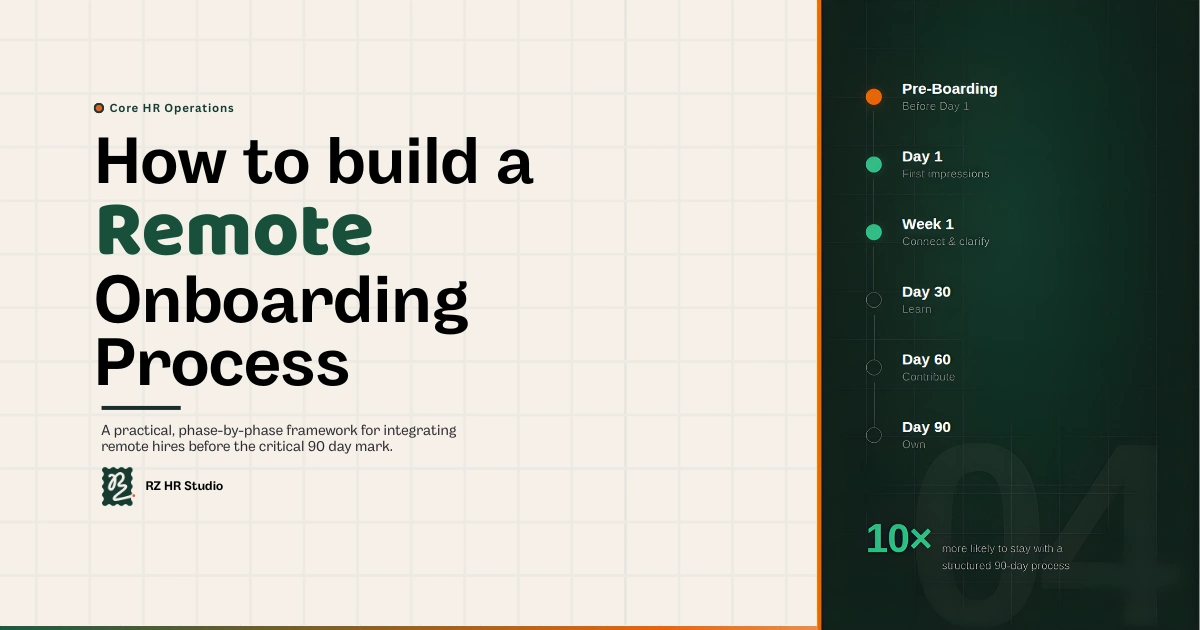
A remote employee onboarding process is the structured series of steps a company takes to integrate a new hire into their role, team, and culture — entirely or primarily through digital tools. Done well, it accelerates performance, builds loyalty, and dramatically improves retention before the critical 90-day mark.
Done poorly, it costs you the hire. This guide gives you a practical, step-by-step framework for building a remote employee onboarding process that actually works — whether you’re welcoming your first remote hire or scaling a distributed team.
TL;DR —
Remote onboarding isn't just about "setting up Slack"—it’s a retention strategy.
The Blueprint for Success
- The 90-Day Rule: Success is measured in phases (Pre-boarding > Day 1 > Week 1> 30/60/90-day plan). Completing this full cycle makes a hire 10x more likely to stay long-term.
- Contextual Tracks: Avoid a "one-size-fits-all" approach. Specifically tailor the experience for contractors vs. full-time employees to reduce friction.
- Tooling: Use a centralized tech stack to eliminate the "Where do I find this?" anxiety common in remote work.
1 in 3
New hires leave within the first 90 days of employment
Source: Yomly / HR Research Institute
What Is a Remote Employee Onboarding Process?
Remote employee onboarding is the process of welcoming, training, and integrating a new hire into your company without a shared physical office. It covers everything from equipment setup and access permissions to role clarity, team introductions, and culture alignment — all delivered through video calls, async tools, documentation, and structured check-ins.
The challenge is straightforward: without hallway conversations, spontaneous lunches, or the ability to lean over and ask a quick question, remote new hires are entirely dependent on what you deliberately build for them. If you don’t build it, they fill in the gaps themselves — usually with doubt, confusion, and disengagement.
Why Remote Onboarding Is Different — And Why It Fails
When a new hire walks into a physical office, the environment does some of the onboarding work for them. They absorb culture by watching people, learn processes by sitting near colleagues, and get feedback in real time. Remote hires don’t have that. Every single thing they need to know must be intentionally communicated.
The numbers tell the story clearly. Only 12% of employees say their company does onboarding well. And 63% of remote employees report feeling undertrained, compared to 52% of their in-person counterparts. The result is a costly retention problem that most founders never saw coming.
The 3 Most Common Remote Onboarding Mistakes
- No structure before Day 1. Equipment arrives late, accounts aren’t set up, and the new hire’s first morning is spent waiting. This destroys confidence before the job even starts.
- Information dumping instead of progressive learning. Throwing every policy, tool, and process at someone in week one overwhelms instead of equips.
- No human connection built in. Purely logistical onboarding — docs, logins, tasks — without intentional relationship-building creates isolated, disconnected employees who start looking for the door.
42%
of fully remote new hires report a “truly terrible” onboarding experience
Source: Gable.to
What a Strong Remote Onboarding Process Looks Like
A strong remote employee onboarding process is built in four phases: Pre-Boarding, Day 1, Week 1, and a 30-60-90 day plan. Each phase has a clear purpose, specific actions, and a feedback loop. Together they give the new hire a runway — not a cliff.
Phase 1: Pre-Boarding (Before Day 1)
Pre-boarding begins the moment an offer is accepted. This phase is about removing every possible friction point from Day 1 before it arrives.
- Send a personal welcome email from the founder or hiring manager — not a templated one
- Ship equipment and confirm delivery before start date
- Set up all software accounts, email, and communication tools
- Share the team handbook, org chart, and role documentation
- Introduce the new hire to their onboarding buddy via email
- Send a pre-boarding survey: preferences, timezone, communication style
A well-executed pre-boarding phase means the new hire arrives on Day 1 ready to connect — not scrambling to get set up.
Phase 2: Day 1 — First Impressions That Stick
Day 1 for a remote employee should feel like a welcome, not a checklist. Resist the urge to schedule back-to-back training sessions. Prioritise human connection and one meaningful first win.
- 1-on-1 welcome call with the founder or direct manager (20–30 minutes): share the company story, define what success looks like, ask what the new hire needs to do their best work
- Team introduction call — short, informal, no agenda
- Tool and system orientation — confirm everything works
- Assign one small, achievable task to complete by end of the week
- Close the day with a brief check-in: “How are you feeling? What do you need?”
Phase 3: Week 1 — Confirm, Connect, and Clarify
The goal of Week 1 is to verify three things: systems are working, relationships are forming, and role expectations are crystal clear. It’s also when most remote new hires decide whether they made the right choice.
🔗 What Is Embedded HR and Why Startups Need It →
- 1-on-1 conversations with two to three key teammates
- Review and sign core documents — employment agreement, NDA, relevant policies
- Attend first team meeting or async standup
- Onboarding buddy check-in (research shows a buddy increases new hire satisfaction by 23%)
- Submit Week 1 feedback: what’s clear, what’s confusing, what do they need?
The 30-60-90 Day Remote Onboarding Plan
The 30-60-90 day plan is the backbone of structured onboarding. For remote employees, it matters even more. Without physical proximity, performance drifts quietly and assumptions go unchecked. The 30-60-90 framework keeps both the manager and the new hire calibrated at every stage.
Days 1–30: Learn
The first 30 days are about absorbing, not producing. The new hire should be learning the company, the tools, the team dynamics, and the expectations of the role — not expected to operate at full capacity.
- Complete role documentation and handbook review
- Attend all core team meetings as an observer
- Shadow relevant processes and workflows
- Complete first independent task
- 30-day check-in conversation: What’s working? What’s unclear?
Days 31–60: Contribute
By day 31, the new hire moves from observer to active contributor. This is when they begin owning small deliverables, participating in discussions with their own perspective, and flagging early concerns before they become problems.
- First independently owned deliverable completed
- Peer feedback collected from one or two teammates
- Culture participation: team rituals, async channels, internal discussions
- 60-day performance conversation with manager
Days 61–90: Own
Day 61 marks the transition to full role ownership. The new hire should know what good looks like, have the tools and relationships they need, and be operating without heavy supervision. Employees who complete a structured 90-day process are up to 10x more likely to stay with the company long term.
- Full role ownership — minimal supervision required
- 90-day formal review completed by both manager and employee
- Role KPIs confirmed and documented for the next quarter
- Onboarding feedback survey: how can the process improve for the next hire?
Remote Onboarding for Contractors vs Employees: Key Differences
Not all new hires follow the same track. If you’re working with contractors — which is common for remote-first and globally distributed teams — your onboarding process needs to reflect the nature of the relationship. Contractors are partners, not employees. Their onboarding should enable great work, not simulate full employment.
🔗 Employee vs Contractor: How to Classify Your Workforce Correctly →
| Onboarding Element | Employees | Contractors |
|---|---|---|
|
Welcome sequence |
Full onboarding plan (4-phase)
|
Streamlined project brief + intro call |
|
Legal documents
|
Employment contract, policies, NDA
|
Contractor agreement, SOW, NDA
|
|
Tool access
|
Full system access
|
Scoped access — project tools only
|
|
Culture |
Deep: team meetings, rituals, values
|
Light: relevant meetings only
|
|
Timeline |
30-60-90-day plan
|
Aligned to project milestones
|
The Tools You Need to Onboard Remote Employees Effectively
Technology doesn’t replace a great onboarding process — but the wrong tools, or no tools at all, will break even a well-designed one. A lean, integrated stack is all you need to start. Avoid tool sprawl; every new login is a new friction point for an already overwhelmed new hire.
- Communication: Slack or Microsoft Teams — your async and sync hub
- Video: Zoom for live calls; Loom for async walkthroughs (ideal for different timezones)
- Documentation: Notion or Google Workspace — handbook, SOPs, role docs, all in one place
- HR Software: BambooHR or Rippling — contracts, employee records, onboarding workflows
- E-signature: DocuSign or HelloSign — fast, friction-free contract signing before Day 1
Start with the essentials and add tools as the team scales. The goal is fewer logins, not more.
How to Build Culture During Remote Onboarding
Culture is caught, not taught — but in a remote environment, you have to be intentional about creating the conditions for it. New hires in a distributed team will not absorb your values by osmosis. Without deliberate design, culture either fails to transfer or transfers inconsistently.
Practical ways to build culture during remote onboarding:
- Schedule a “get to know you” call with two to three teammates in the first week — non-work topics only
- Share the origin story: why the company exists, what the founder believes, what you stand for
- Make async channels feel welcoming — a #welcome channel, a #wins channel, a #random
- Give the new hire a cultural contribution in month one: lead a short update, share a win, ask a question in a team channel
- Share examples of how the team celebrates, handles conflict, and supports each other
Employees who feel genuinely connected to their team’s culture within the first 90 days are 86% more likely to still be with the company at the 6-month mark.
Stop Leaving Remote Hires to Chance
A remote onboarding process isn’t just an HR checkbox—it’s a retention insurance policy. In a distributed world, culture and clarity don’t happen by accident; they must be designed.
By replacing the “sink or swim” approach with a structured 30-60-90 day framework, you provide new hires with more than just a laptop—you give them the roadmap and confidence to perform. The ROI is clear: higher engagement, faster productivity, and lower turnover costs.
Your HR Partner
At RZ HR Studio, we embed directly into your business and build the people infrastructure that protects you — including workforce classification frameworks tailored to your team structure, your geography, and your growth stage.
Book a Free Discovery CallNo pitch. Just clarity on where your workforce classification stands — and what it would take to make it bulletproof.